
Beyond the Tyranny of U-Values
What our test enclosures tell us about heat & comfort - why building materials matter and why building regulations could do with an update
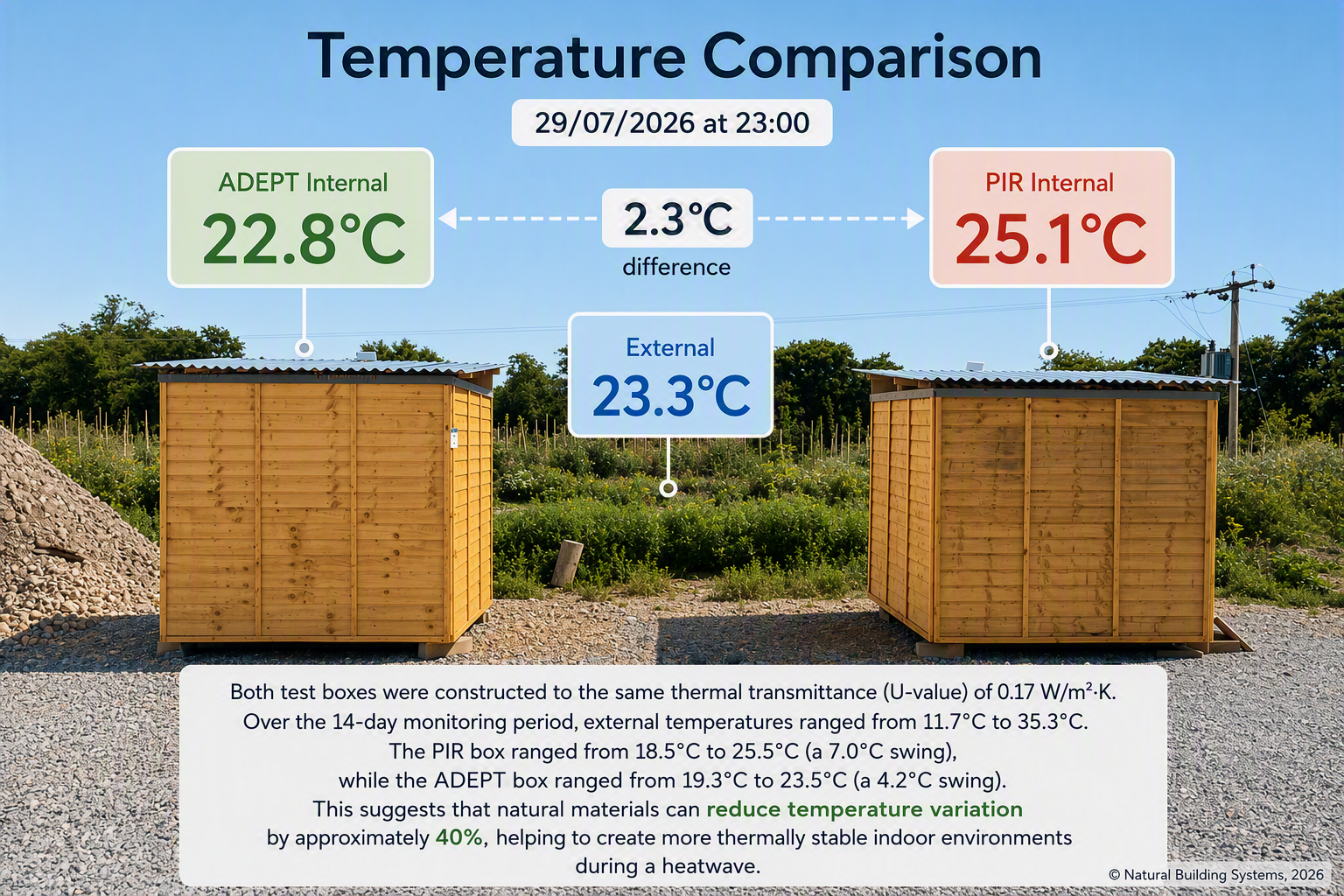
This summer has brought another reminder that building performance is no longer just about staying warm in winter.
Across the UK we have seen prolonged periods of hot weather, leading to an increase in serious wildfires including in our backyard in East Anglia. As temperatures rise, comfortable buildings are becoming harder to achieve and more expensive to maintain. After fire tragedies such as Grenfell, regulations have been tightened favouring certain materials. As the climate changes, with overheating experienced more frequently, we should similarly update regulations to ensure better materials are specified to help Britain’s buildings and people cope with the changing climate.
For decades, insulation discussions have focused heavily on U-values and the importance of keeping heat in. They remain important, but anyone who has walked into an overheated room on a summer afternoon knows they are not the whole story. As summers become hotter, the buildings we design and retrofit also need to keep unwanted heat out. This is where the choice of material starts to matter in ways that a U-value alone cannot explain.
Terms such as thermal mass, decrement factor and decrement delay mean a great deal to building scientists, but there’s no mention in building regulations (Approved Documents L & O), meanwhile most people just want to know whether a building will stay comfortable during a heatwave.
As part of our ongoing research into the benefit of building with materials derived from High Carbon Capture Crops, we built two identical test enclosures and monitored how they behaved under real summer conditions to provide quantifiable and visual tools to explain WHY building with natural materials is better for building occupants as well as the planet. We built two identical boxes except one used our bio-based ADEPT® system. The other used conventional timber-stud construction insulated with PIR foam.
Both enclosures had the same dimensions, the same internal volume and the same U-value. The results showed that they still performed very differently.
Looking beyond U-values
Why do some buildings overheat whilst others don’t? Things like orientation, ratio of glazing and ventilation are all important, but people often overlook the wider role of building materials on thermal comfort.
The length of time it takes for thermal energy to pass through a material is known as the decrement delay. The value of a decrement delay is that when the outside heat is at its maximum (at for example mid-day), this heat is only transferred to the interior during the evening when the inside of the building is relatively cool. The optimum delay is considered to be between 8 and 12 hours depending on climatic conditions. This is combined with decrement factor which relates to the overall temperature difference between the peak internal and external temperatures.
Put simply, a good decrement factor softens the temperature swing, while a good decrement delay postpones its arrival.
Why bio-based materials behave differently
Heat transfer is influenced by three main material properties:
Specific heat capacity, c (J/kg.K): the amount of heat needed to raise one kilogram of a material by one degree Kelvin. A change of 1 K is the same size as a change of 1 C.
Density, ρ (kg/m3): the mass of a material per unit volume.
Thermal conductivity, λ (W/m.K): how readily heat travels through a material.
These values are usually presented as fixed, or static, numbers. Real buildings rarely operate under static conditions and in the case of Specific Heat Capacity, the dynamic nature of heat transfer is affected not only by the statically measured specific heat capacity of the material but also by thermodynamic effects caused by the very transfer of the thermal energy.
This is particularly evident in vapour permeable materials, and is where hemp-based materials become interesting.
Hemp shiv, the woody core of the hemp stem, contains a complex network of interconnected pores. As humidity within those pores rises and falls, moisture is adsorbed and desorbed. That process also releases and absorbs thermal energy.
The result is an additional buffering effect often described as “virtual thermal mass”. In simple terms, some of the thermal energy is temporarily absorbed or released through moisture changes rather than passing straight through the material. Internal temperatures can therefore change more slowly and more gently during rapid changes outside.
Seeing the effect in hemp shiv
This effect can be measured in the laboratory using differential scanning calorimetry (DSC). The detail matters, but the central point is simple: changing the humidity around hemp shiv produces a measurable thermal response.
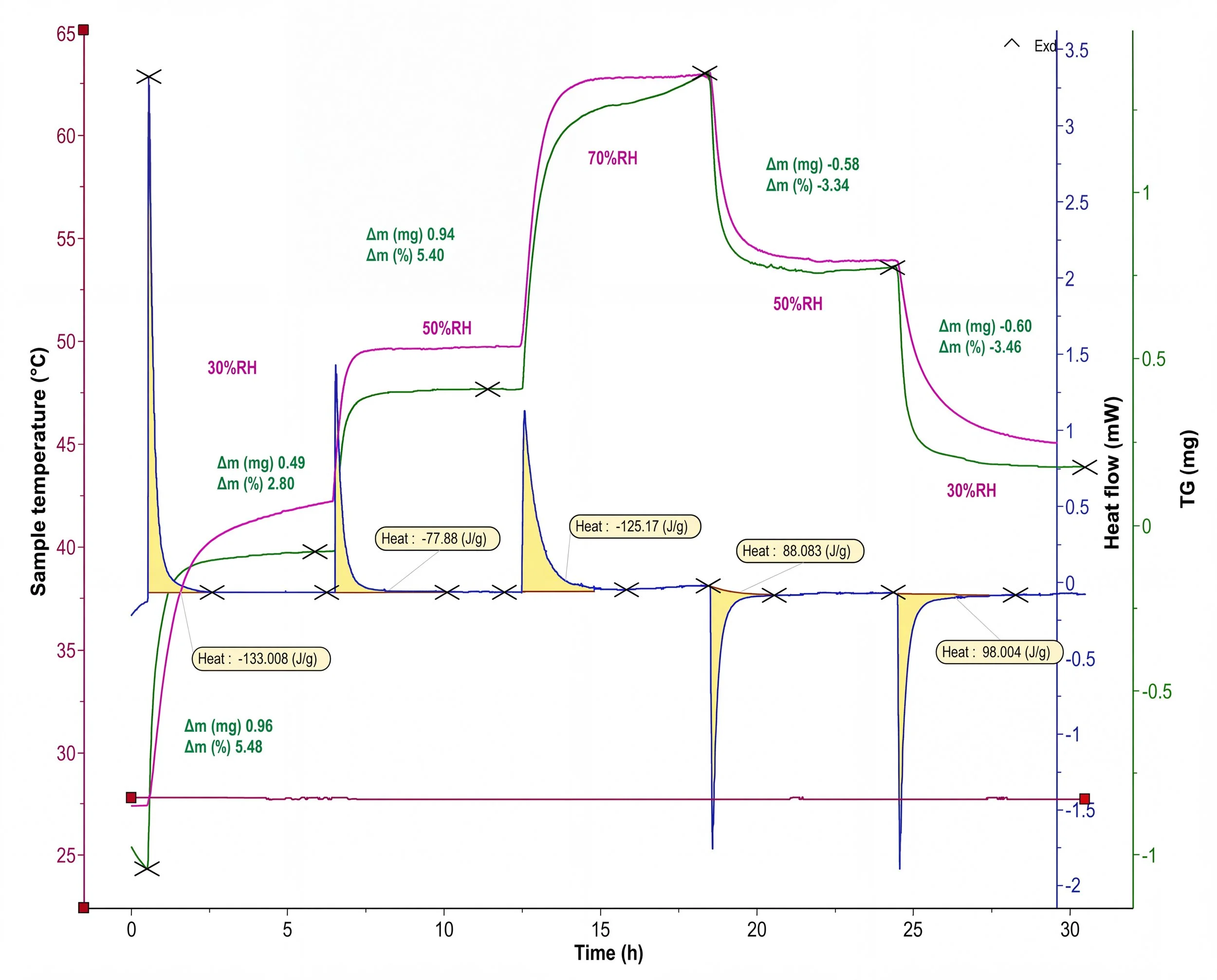
Figure 1. DSC on hemp shiv showing thermal effects induced by isothermal humidity changes (Lawrence, 2015).
Figure 1 records the thermal effects of moisture sorption and desorption within the pores of a specimen of hemp shiv (the woody core of the hemp stem). The experiment used a SETARAM SENSYS DSC at a constant 27 C. The specimen was exposed to relative humidity levels of 30%, 50% and 70%, first increasing and then decreasing.
When humidity rose, moisture condensed within the pores and released energy through the latent heat of water. When humidity fell, moisture evaporated and absorbed energy from the system. In this experiment, condensation within the hemp shiv released up to 133 J/g.
The latent heat of vaporisation of water is very high at 2,260 kJ/kg. This helps explain why heat can take longer to move through hemp shiv than through a material with a less complex pore structure, such as polyisocyanurate insulation (PIR).
Laboratory data helps us understand why this happens. But our m3 enclosure test was designed to show what that difference looks like in real conditions.
The box test
At our ADEPT® production site in Halesworth, inspired by the Ice-Box challenge, we constructed two matching m3 test cubes.
The ADEPT® enclosure used our standard modular cassette system, containing layers of hemp fibre and HempSil (our shiv based composite). The other used conventional timber-stud construction with PIR insulation. Both had the same internal volume and external dimensions, and both were designed to achieve a U-value of 0.17 W/m2.K.
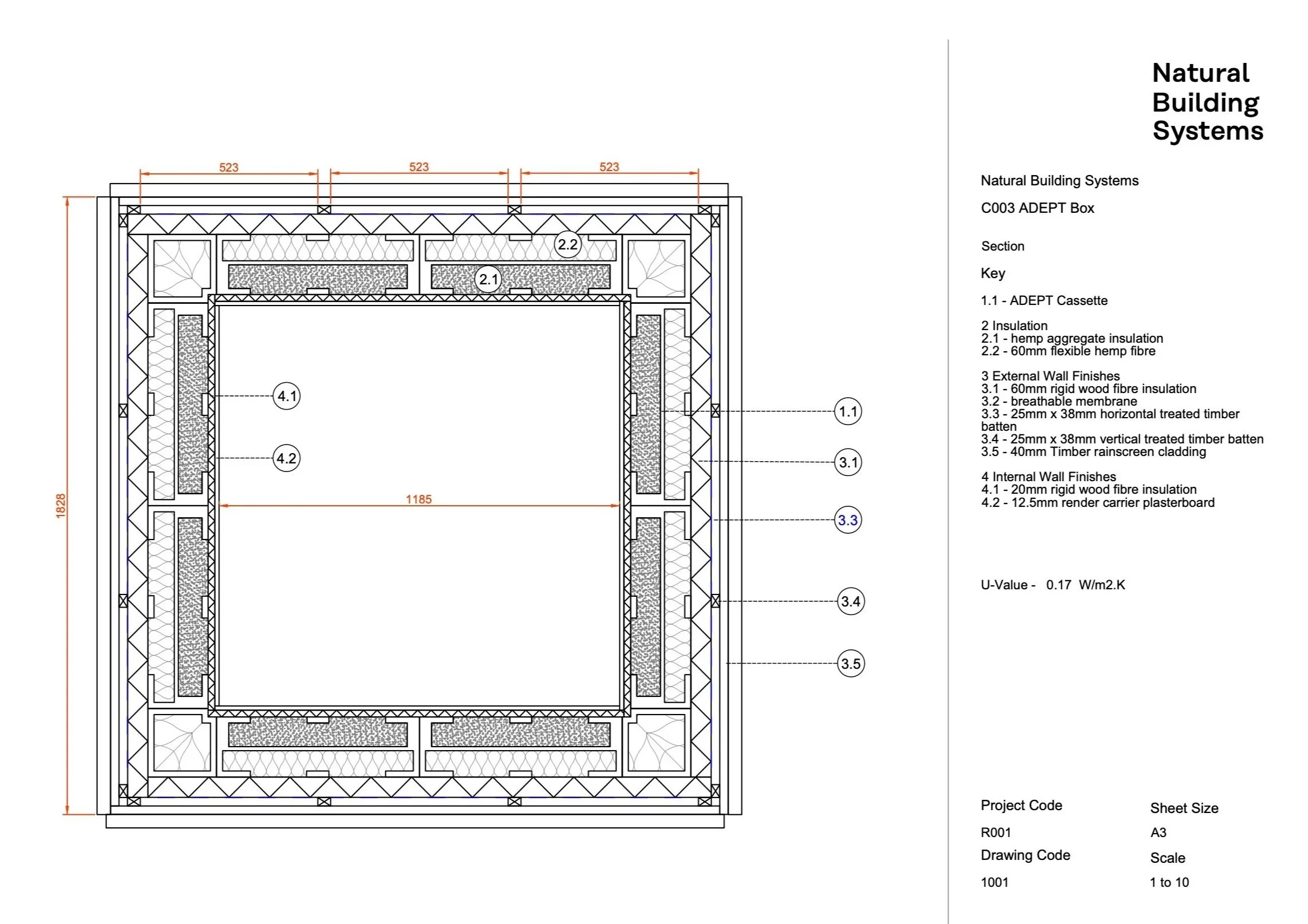
Fig.2 ADEPT® (bio-based) test enclosure
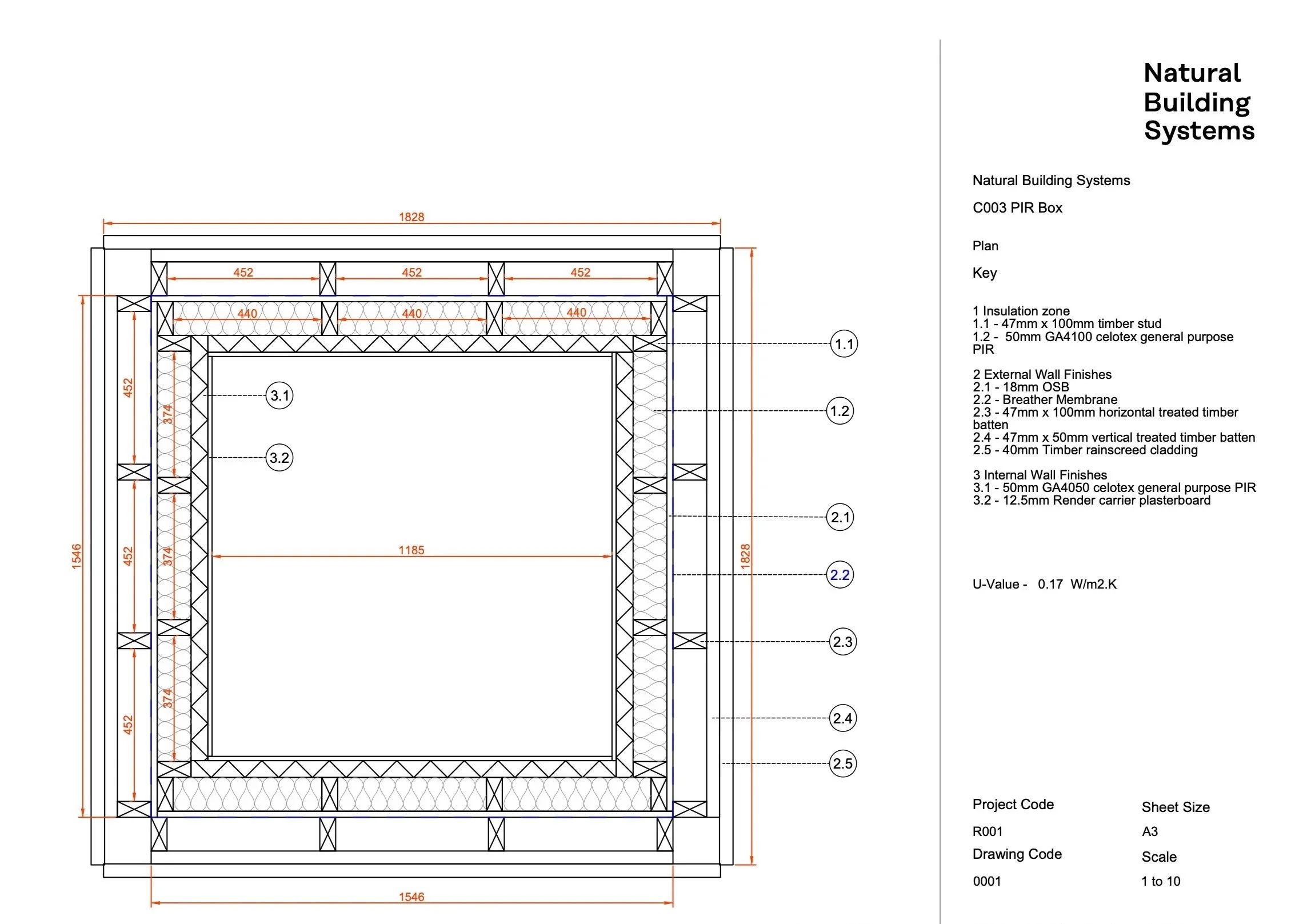
Fig.3 PIR test enclosure
We installed temperature and relative humidity sensors inside and outside both enclosures. Internally, sensors were placed 100 mm below the top centre, at the geometric centre, 100 mm above the bottom centre, and at the centre of the north- and south-facing walls underneath the rainscreen
For this experiment, the external temperature represents that experienced beneath the rainscreen, at the outside of the insulated envelope. That is the relevant exposure for comparing how heat moves through the two insulation materials. Internal temperatures are those at the geometric centre of the respective enclosures.
The enclosures stood next to one another, far enough apart to avoid overshadowing, with one face of both oriented due south.
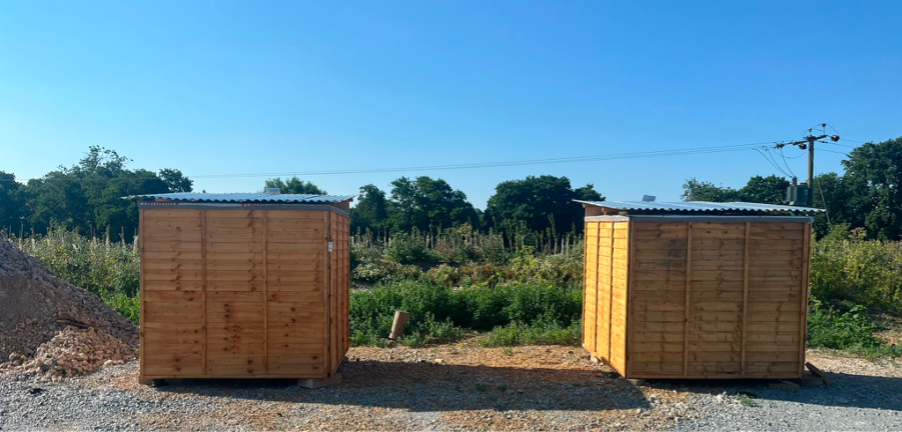
Figure 4. ADEPT enclosure (left) and PIR enclosure (right)
What happened?
So far temperature and relative humidity have been recorded every ten minutes between 22 July and 6 August 2026. During that period, the external sensor beneath the rainscreen recorded temperatures from 11.4 C to 34.1 C, a variation of 22.7 C.
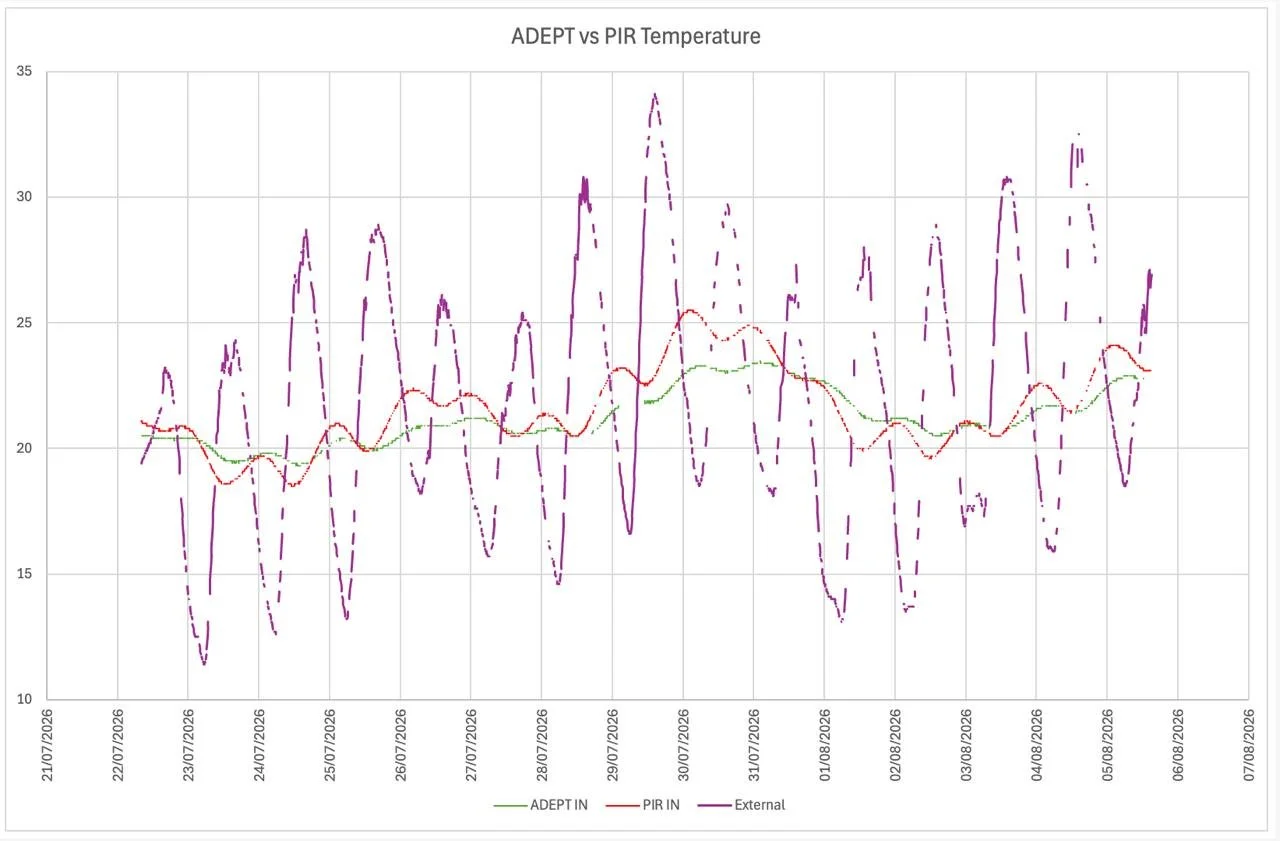
Figure 5. External temperature beneath the rainscreen and temperature at the geometric centre of the ADEPT and PIR enclosures.
Inside the PIR enclosure, temperatures ranged from 18.5 C to 25.5 C, creating a 7 C swing. The measured decrement delay was six hours. Compared with the 22.7 C external swing, internal temperature variation was reduced by around 69%.
Inside the ADEPT® enclosure, temperatures ranged from 19.3 C to 23.5 C, creating a smaller swing of 4.2 C. The measured decrement delay was ten hours, and internal temperature variation was reduced by around 81.5%.
The two enclosures faced the same conditions and had the same U-value. The ADEPT® enclosure kept its internal temperature more stable and delayed the arrival of peak heat for four additional hours. The experiment will continue to run for a full 12 months.
Why it matters
Buildings are experienced by people, not by thermometers. The difference between a room that quickly follows external temperature swings and one that remains stable can become the difference between comfort and discomfort during extreme weather.
Our test indicates that the density, specific heat capacity and hygrothermal behaviour of hemp-fibre and Hempsil are providing benefits that can not be fully described or represented by U-values alone.
In this dataset, the ADEPT® enclosure delivered a 67% longer decrement delay than the PIR enclosure. Its internal temperature swing was also 40% smaller. Of course, one added benefit is that such buildings will also need less powerful heating and cooling equipment – a reduction in both cost and embodied carbon.
As heatwaves become more common, those differences will matter more. U-values remain an essential measure of performance, but buildings designed for year-round comfort and resilience also need to account for how quickly heat moves through the fabric and how strongly internal temperatures respond. That means future building regulations should recognise the contribution bio-based materials can make to overheating resilience, alongside glazing, ventilation and building orientation. If Part O is to sit with equal weight alongside Part L, the current dominance of U-values needs to be balanced by a fuller understanding of fabric performance in a warming climate.
Project support
This work has been supported through the Centre for High Carbon Capture Cropping (CHCx3) project, a multi-partner programme led by NIAB that is helping to develop uses and value chains for high-carbon-capture crops, including renewable biomaterials for construction. Find out more about CHCx3
Reference
Lawrence, M. (2015). Reducing the Environmental Impact of Construction by Using Renewable Materials. Journal of Renewable Materials, 3(3), 163-174. View the article